
Size a portable or small commercial generator from a real load list, not floor area: running and starting watts, simultaneity, reserve and supplier sizing inputs.
In this guide6 sections
The right generator size comes from a load list, not from floor area or a generic wattage chart. List the loads that run at the same time, record each load's running and starting demand, decide which motors start together, add an operating reserve, then ask the supplier to recommend a set by continuous rating, transient capability, voltage, frequency, phase and site conditions. Keep the size on HOLD while any major load or its start-up behaviour is unknown. This guide is for importers, distributors, rental fleets and OEM/private-label buyers turning an application into a supplier-ready request.
Why floor area and generic wattage charts fail
Floor area does not identify the equipment, running demand or motor starts a generator must support. Use the customer’s equipment list, nameplates and intended operating pattern as the sizing inputs; a generic wattage chart cannot confirm the required set.
Build the load list
Write one row per load that can run in the same period. For each load capture its running (continuous) demand and its starting (peak) demand from the nameplate or manual — not from a chart.

Resistive loads (lighting, heaters) draw close to their running value at start. Motor-driven loads (pumps, compressors, air-conditioning) draw a much higher, brief starting current. Record both, and mark loads that are essential versus deferrable. The starting versus running watts guide explains the two values in detail.
Handle motor starting and simultaneity
Check both the steady running load and the worst realistic starting event. For one motor starting, combine its total starting demand with the demand of other equipment already running; do not add that motor’s running demand again. If a source gives additional starting watts instead of total starting watts, keep that definition explicit. Record overlapping starts and assess them together. Honda’s power-management guidance illustrates why the operating sequence matters; the supplier must still confirm the transient capability of the quoted set.
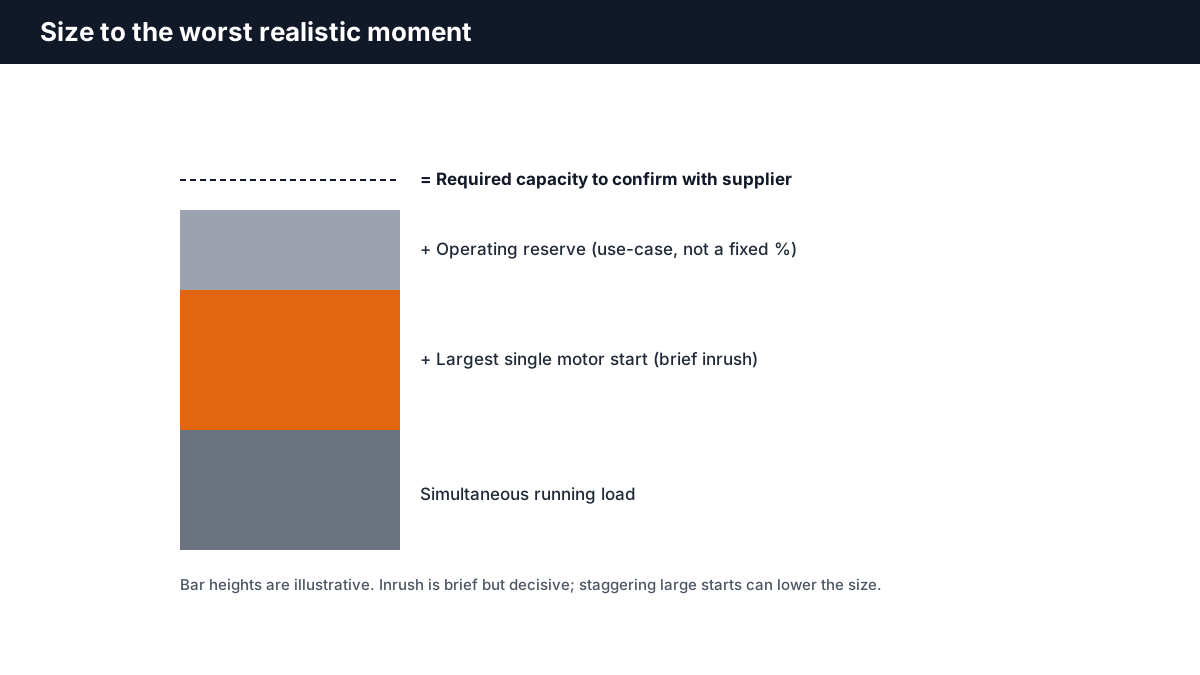
Motor inrush also causes voltage dip; a set that survives the watt total can still fail a sensitive load if the transient is too deep. The motor-starting inrush and voltage-dip guide covers this transient behaviour, which is a model-specific property to confirm.
Add the right reserve — and keep the label basis honest
Add an operating reserve for growth, ageing and non-ideal conditions, sized to the use case rather than a fixed percentage. Then keep the rating basis honest: compare sets on continuous (rated) output, not peak, using the rated versus peak guide. A large peak number does not mean the set can carry that load continuously.
Turn the load list into supplier sizing inputs
Sizing is only final when a supplier confirms a specific model against your list and site. Convert the worksheet into a request.
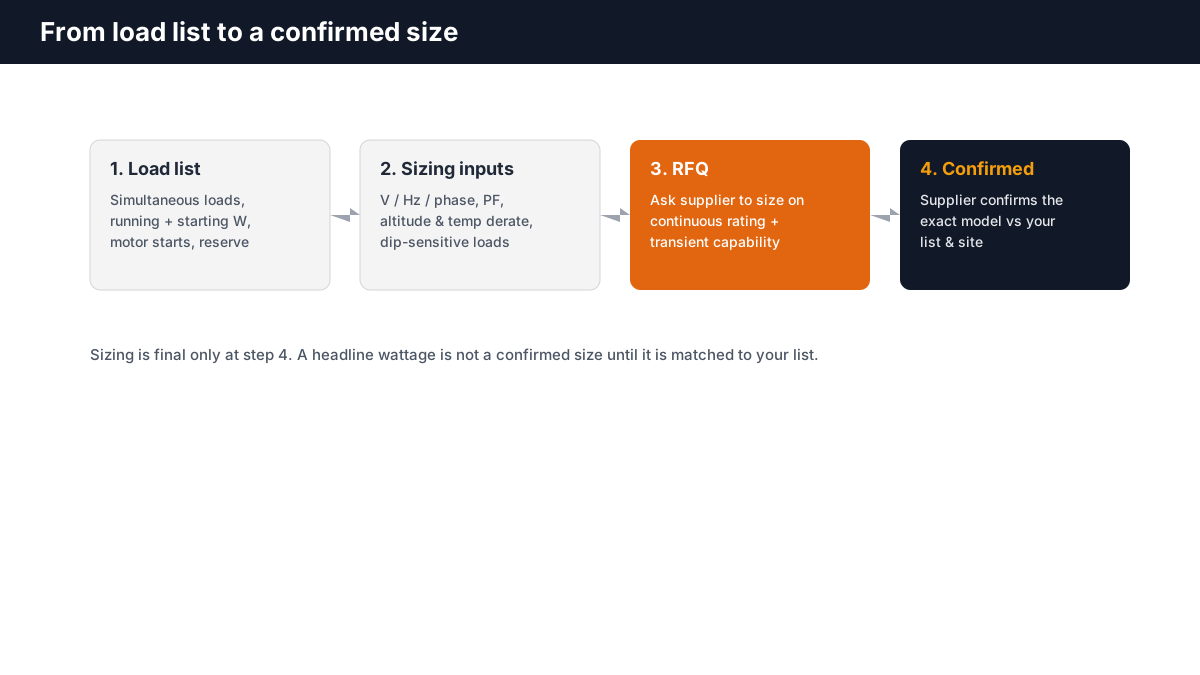
Send the supplier:
- Total simultaneous running load and the largest single motor start.
- Which motors start together versus staggered.
- Required reserve and any planned growth.
- Voltage, frequency, phase and power factor for the destination.
- Site altitude, ambient temperature and enclosure/airflow limits (which derate output).
- Any load sensitive to voltage or frequency dip, with its limit.
Destination supply detail follows the voltage and frequency checklist; larger or multi-load projects use the industrial sizing guide.
Common mistakes to avoid
- Sizing from floor area or a generic chart instead of a nameplate load list.
- Using peak/maximum watts as if they were continuous output.
- Ignoring motor inrush and starting several large motors together.
- Forgetting altitude and temperature derating for the destination site.
- Treating a supplier's headline wattage as confirmation without matching it to the list.
Send your load list and site conditions to request a quotation. BEAR recommends and confirms the exact model against your loads, transient needs and destination; sizing is verified for the quoted build rather than assumed from a chart.