
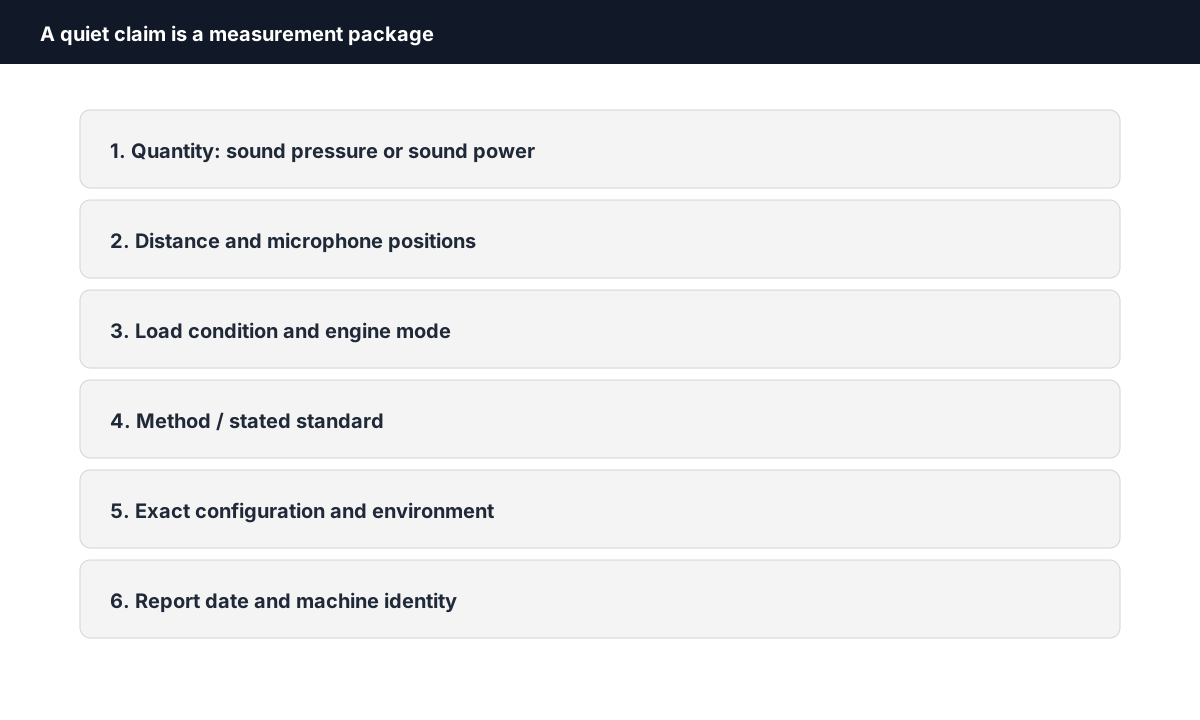
Treat a quiet claim as a measurement package: quantity, distance, load, method and configuration. Incomplete dB(A) numbers stay on HOLD.
In this guide5 sections
“Quiet” is not a specification until the buyer can reconstruct the measurement. A usable claim is a package: the acoustic quantity, distance and positions, load condition, method or stated standard, exact machine configuration and environment. A bare “62 dB(A)” line without that package stays on HOLD.
This page is for importers, distributors, rental fleets and private-label buyers who must list or rent a portable set next to people, events or occupied buildings. It does not interpret local noise law and it does not publish a BEAR decibel figure.
Turn quiet into a use-case requirement
Start with who hears the machine, where they stand, how long it runs and at what load. A rental yard, a service vehicle, an event perimeter and a construction shift near occupied rooms are different requirements. The adjective belongs to that case, not to a catalogue badge.
Do not use this page to choose open frame versus canopy. That architecture decision is already on open-frame versus enclosed. Inverter form-factor, weight and runtime stay on portable inverter selection.
Ask what the number means before you compare it
One supplier may publish sound pressure at one distance and one load; another may publish sound power, a different distance, a no-load figure or an unstated enclosure. A lower number is not automatically a quieter machine if the packages are not the same.
Ask every supplier for: quantity (pressure or power), weighting if stated, distance and positions, load and engine mode, method or standard, configuration (enclosure, exhaust, panels), environment and report date. Tie the file to the quoted model and revision, as in documents before order.
ISO 8528-10 describes methods for airborne noise of reciprocating engine-driven generating sets. It makes results more comparable when the method is named. It does not certify a BEAR model and it does not replace a field check at the buyer’s distance and load.
Do not treat a category filter as evidence
Retail “below 60 dB” shelves and “super quiet” collections are merchandising, not a shared test recipe. Do not copy a competitor ranking into a listing. Do not invent a BEAR target in dB(A).
If the buyer’s customer has a contractual limit, write the quantity, distance, load and method they will use to check it. If they have no method, the limit is incomplete and the SKU stays HOLD for that customer.
A field observation is useful only when distance, load, positions and machine identity match the catalogue package — or when both sides agree the field method replaces it. A phone recording next to the set is not a measurement package.
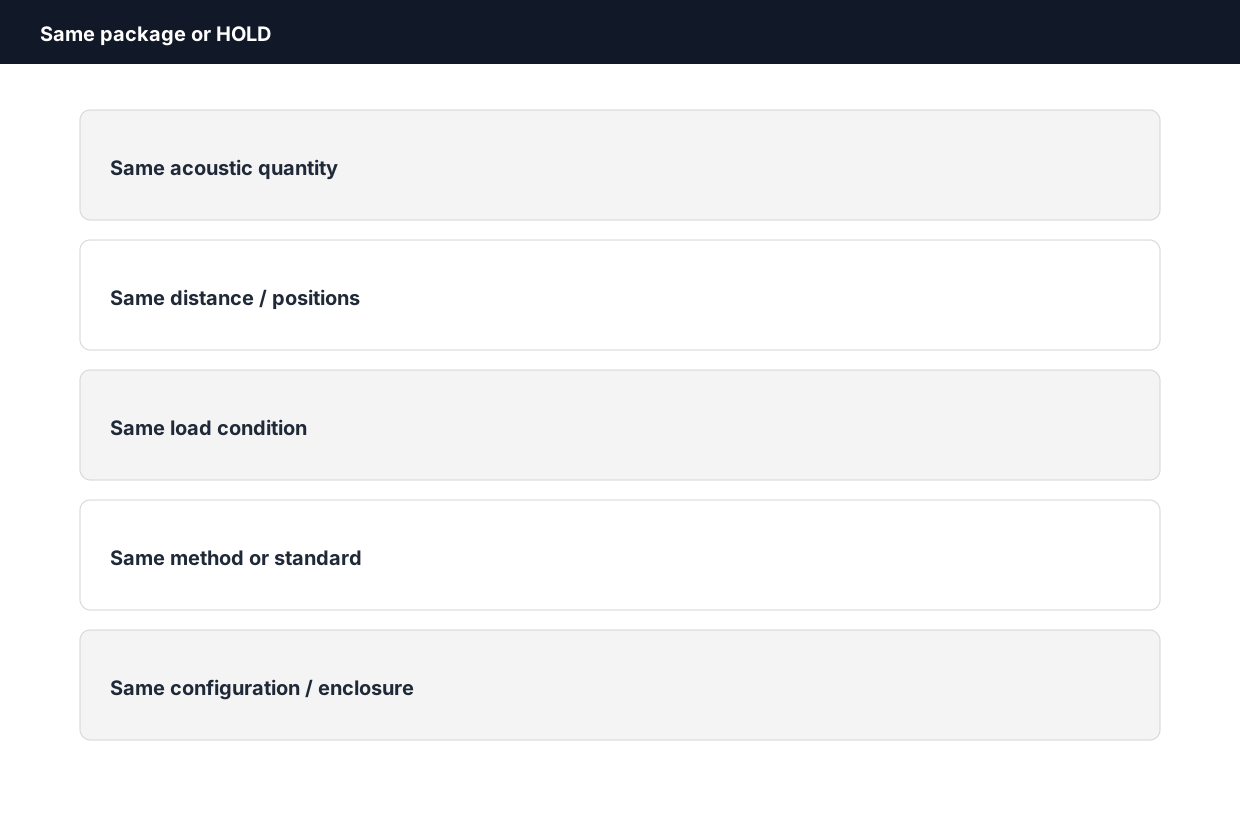
Quiet HOLD table
| Field | Passes | HOLD |
|---|---|---|
| Use case | Listener, distance, duration and load are named | Only the word quiet |
| Quantity | Pressure or power is stated | A lone dB(A) with no quantity |
| Geometry | Distance and positions are written | “At the set” with no method |
| Load | Load and engine mode match the intended use | No-load number sold as working quiet |
| Method | Standard or procedure is named | Ranking table or shop filter |
| Identity | Report matches the quoted revision | File from another enclosure or SKU |
| Field check | Same package or an agreed substitute | Phone video as proof |
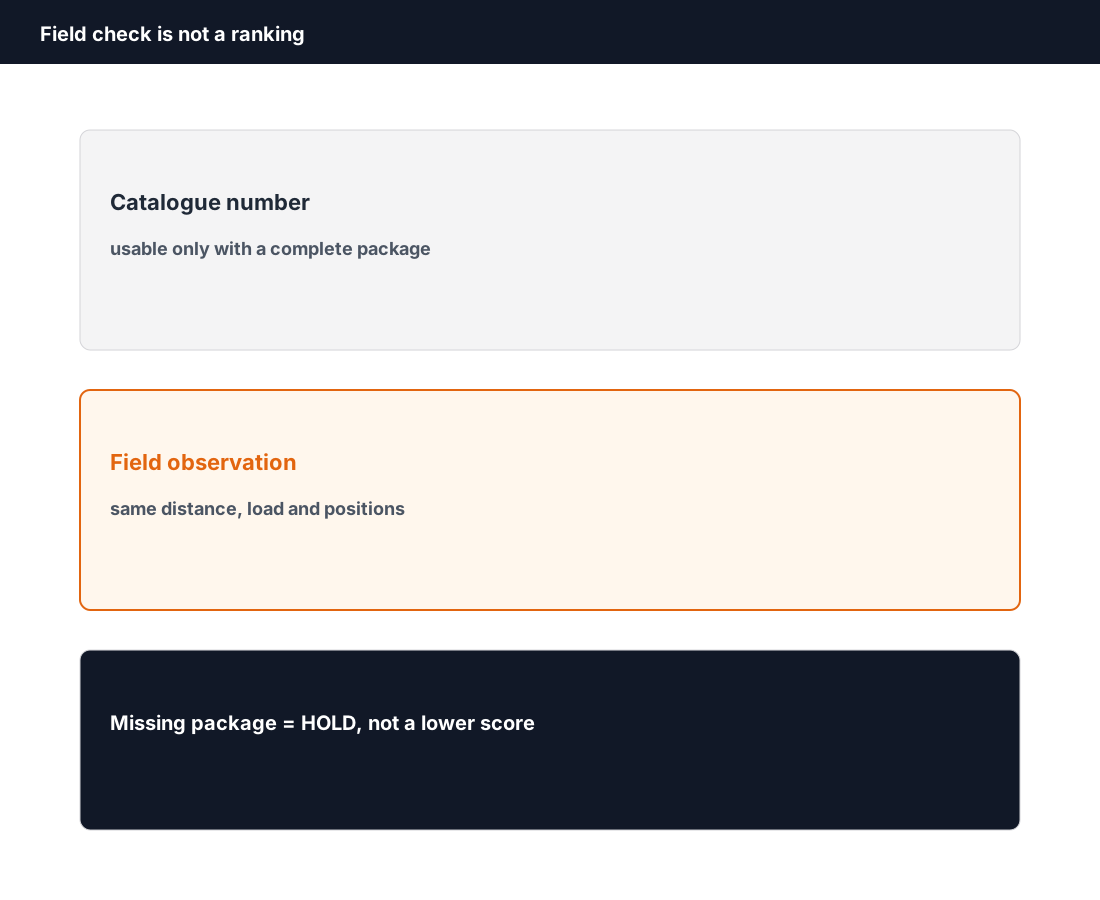
What to send with the request
State the market, nearby listeners, required listening distance if any, typical load, duration, outdoor placement constraints, voltage, frequency, phase, quantity and whether a field check is required. Quiet operation does not make a fuel-powered portable generator suitable for indoor use; follow the CPSC portable-generator safety guidance on outdoor placement away from building openings.
Ask the supplier to return the exact model and revision, the full measurement package, the report tied to that revision, enclosure identity, the matching manual and what is excluded. Start from the gasoline generator category or inverter category. Noise claims are confirmed only on the named file through the project form.