
Compare open-frame and enclosed generators by noise, weather exposure, maintenance access and transport. Use a site comparison and quotation request.
In this guide10 sections
An open-frame generator leaves more of the engine and generating assembly visible within a supporting frame. An enclosed generator surrounds them with panels or a canopy. Choose by the task those features must serve: reaching service points, controlling access, meeting a stated sound criterion and fitting the operating site. Neither construction name establishes noise, weather protection or rated power.
Start with the comparison below, then use the detailed site matrix to request matching offers. For portable generators, an enclosed case does not make indoor use safe: CPSC's portable-generator guidance warns against use in homes, garages and similar enclosed spaces. Site installation, exhaust and electrical work require the applicable instructions and qualified review.
Which construction fits your buying task?
| Buying task | What to examine on an open-frame option | What to examine on an enclosed option |
|---|---|---|
| Routine service | Reach to filters, drains, battery and controls; guards or frame members in the way | Door opening, removable panels and the route for the same service tasks |
| A defined noise limit | Exact-model sound result under your comparison conditions | Sound result for the quoted canopy, including the required panel state |
| Public access or tampering | Supplied guards, control access and the site's separate access controls | Included locks, doors and protected controls; a canopy alone does not close the site requirement |
| Outdoor exposure | Manufacturer's operating and storage limits for that build | The same limits, plus any documented enclosure protection claim |
| Moving or shipping the set | Approved handling arrangement and separate product/packed dimensions | The same information, including any canopy or accessory changes for transport |
If the two offers satisfy the same requirements, compare their complete supplied price and service costs. If the requirement is still vague, such as "quiet enough" or "suitable outdoors," define it before selecting either construction.
Keep construction labels separate from performance claims
Preserve the supplier’s exact wording. Open-frame, enclosed, canopied, silent, sound-attenuated, and weatherproof are not interchangeable terms. A quotation should state which physical construction is included, then support any acoustic or environmental claim separately.
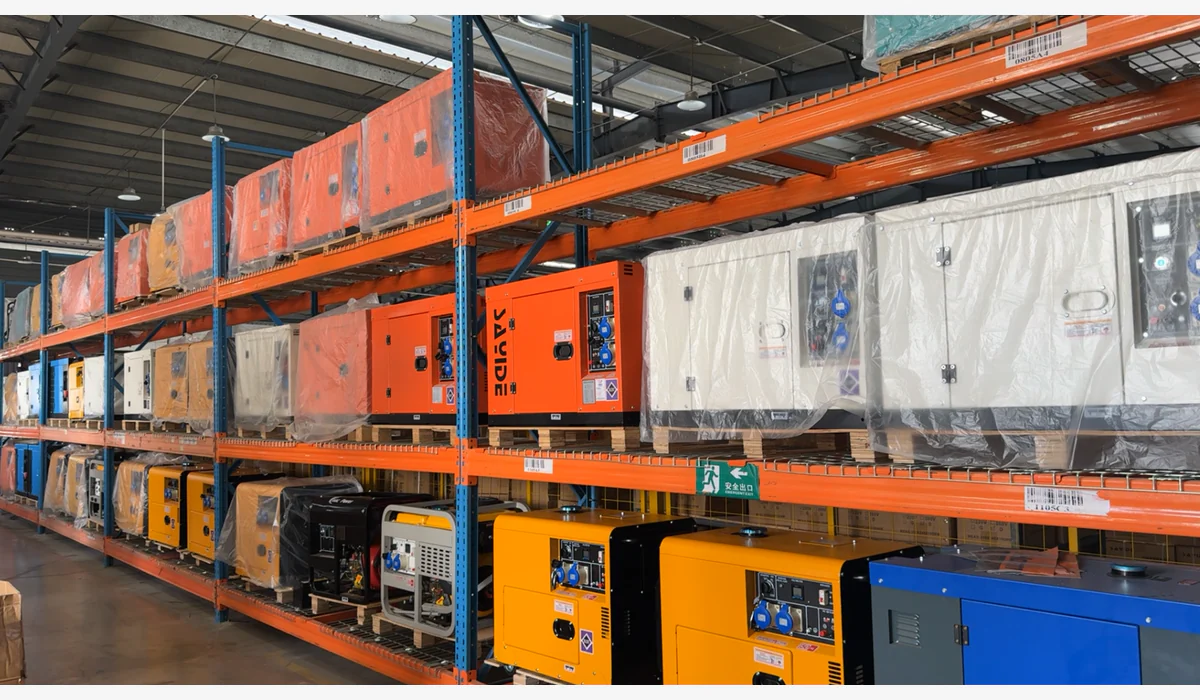
Neither format wins every task. An open unit may still have difficult service access; an enclosure does not by itself prove weather protection or lower noise. Compare weight, price, safety, cooling and security only from records for the exact build and proposed site.
Match the quoted model and frame or enclosure to the drawings. Then cross-check the fitted panels, doors, locks, guards, wheels, drains, handling items, controls and options. A photo of a similar unit can suggest questions but cannot prove what ships.
For a private-label open or enclosed build, carry the exact panels, doors, guards, handling features, controls and option revisions into the BEAR OEM and private-label project review. The construction choice remains open until the branded configuration and site matrix describe the same unit.
Define the site and daily work
State where the set will run and where it will be stored. Record weather, dust, heat, cold, salt exposure and public access. The maker's limits must cover the intended state. A place described as outdoor or sheltered still needs a proper site review.
Then list the work people must do: inspect, start, refuel, clean, service and move the set. For each task, note the point to reach and the door or panel that must open. Keep the required working space and removal path on the site plan.
The industrial generator sizing guide covers the load and duty questions. For this construction comparison, use the same load reference for both offers. Qualified site reviewers must settle placement, airflow, exhaust, fire controls and electrical work.
Compare sound and weather claims separately
A canopy can be part of a sound-control design, but its presence does not supply a sound result. Ask for the exact model, load, test method and metric. For sound pressure, retain the distance or position too. The phrase silent generator is not a measurement.
For weather exposure, state whether the requirement applies while running, stored or transported. Match any protection claim to the quoted panels, seals, vents and options. A picture cannot establish a tested rating.
Cooling needs its own check. The drawings and manual should identify air inlets, outlets and the required operating state of doors or panels. The site reviewer can then compare that layout with the proposed placement. Neither open space nor a visible vent proves adequate cooling.
Example: when two noise numbers cannot choose the winner
Hypothetical quotation example; these are invented labels, not test results or BEAR specifications. Offer A says 70 dB(A) at 7 m and half load. Offer B says 68 dB(A) at 1 m without naming the load.
The numbers do not establish that B is quieter. The distance and load basis differ, and both suppliers still need to name the sound quantity and method. Request comparable results under the buyer's agreed conditions. Do not convert the figures with a generic distance rule and treat the answer as a measured product result.
Compare actual service tasks
An open frame may give a clear view of components while a guard or frame tube still blocks a service task. An enclosed unit may provide doors that reach the needed points. The useful question is which arrangement lets the planned work happen at the site.
| Task | Information to compare on both builds |
|---|---|
| Inspection | Visible points, guards and panels that must open |
| Routine service | Access to filters, drains, battery and other manual-listed items |
| Repair | Removal route for the affected part and the required workspace |
| Public access | Included locks and guards, control access and separate site measures |
| Recovery | Documented handling arrangement and the state of doors or panels |
For a sample review, request views from all sides and closer views of service points. Label each item included, optional, excluded or site-supplied. Match the sample identity to the quote so a feature on a different unit does not enter the order by mistake.
Keep handling and freight data separate
The product and its shipping package are different states. Obtain the product dimensions and mass for site planning, and packed dimensions and gross mass for freight. Keep fitted accessories and loose packages explicit.
Tubes, wheels, handles or hooks in a photograph are not approved lifting points. Use the exact build's handling instructions and an appropriate plan; this guide does not supply one.
For a useful sample record, log each mismatch in this form:
| Observation | Quoted item | Supplier response needed |
|---|---|---|
| A visible feature is absent from the quote | Frame, door, lock, wheel, control or other item | State whether it is included, optional or excluded |
| Sample and drawing differ | Model and document revision | Identify the ordered build and issue the matching drawing |
| Only product mass is provided | Packed configuration | Supply gross mass, package count and packed dimensions for freight |
A discrepancy asks for clarification; it is not by itself proof of a defective product. Keep the observation and the final response with the order.
Build the Open-versus-Enclosed Suitability Matrix
Send the same matrix for both offers. Each required row should connect a site need to an exact build and its supporting file.
| Matrix row | Buyer input | Supplier evidence | Gate test |
|---|---|---|---|
| Exact build | Required construction and supplied-scope fields | Quote, options, drawings, revisions, controlled photo set | Does every source describe the same build? |
| Exposure | Actual operating and storage conditions | Exact environmental claim and applicable evidence, conditions, exclusions | Can the named owner review it? |
| Acoustic | Metric, load, distance, environment, evidence requirement | Exact test configuration and result basis | Does it match the buyer criterion? |
| Cooling and interfaces | Placement inputs and responsible reviewer | Exact inlet/outlet layout and applicable documents | Is the interface review possible without inference? |
| Access and security | Inspection, operation, public-access and tamper workflow | Included panels, doors, locks, guards, controls | Do visible features match supplied scope? |
| Service and removal | Service tasks, window, access and removal path | Exact points, panel states, dependencies, drawings | Can each task be reviewed? |
| Fuel/refill | Project fuel and housekeeping boundary | Exact layout, included scope, documents, exclusions | Are owner and boundary clear? |
| Handling and freight | Movement state, route, recovery and shipping requirement | Configuration-specific handling data plus separate packed data | Are the states kept separate? |
| Destination files | Market and approval owner | Exact applicable documents and revisions | Is scope independently reviewable? |
| Change control | Deviation and approval authority | Substitution/revision register and closure route | Are changes controlled before acceptance? |
A low price cannot resolve a missing requirement or a conflicting build. Close those gaps before selecting a model.
Apply the COMPARE / RETURN / HOLD gate
Use the gate on every critical matrix row before comparing total price or choosing a construction.
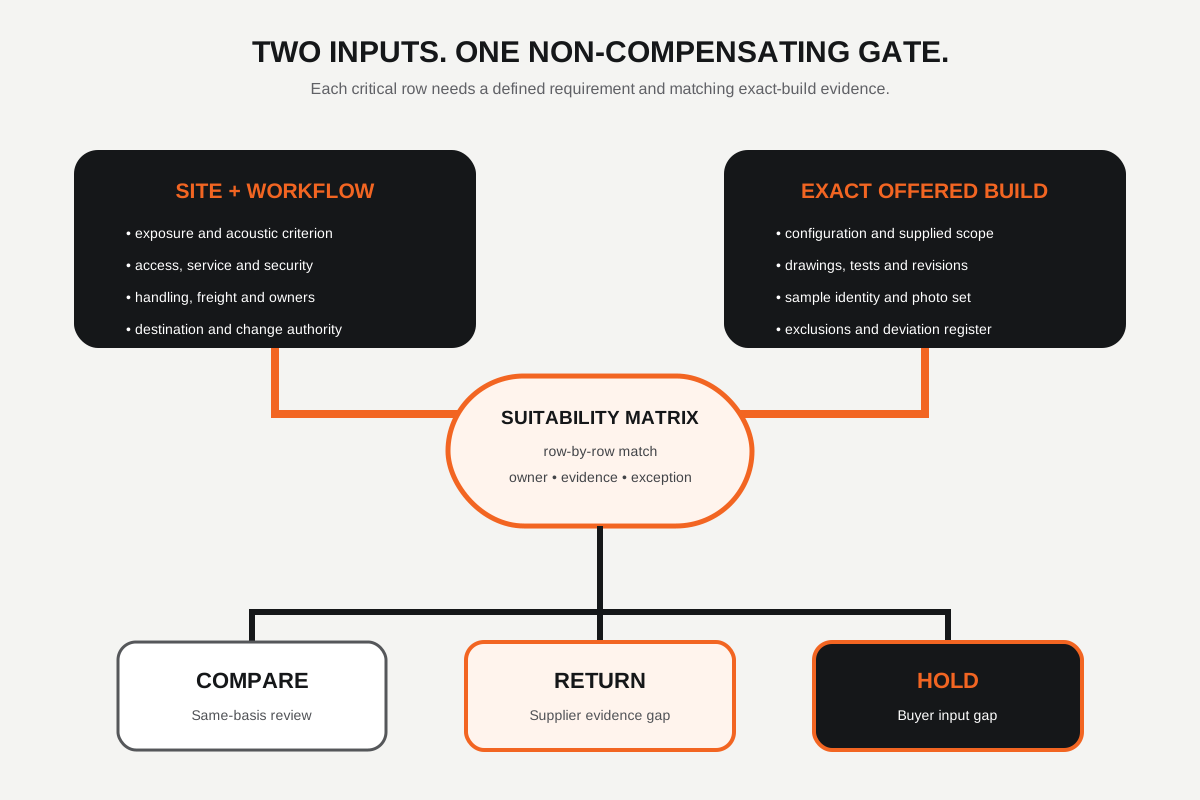
- COMPARE: the site requirement is defined, the offered configuration is reconciled, and exact-build evidence supports a side-by-side review.
- RETURN: supplier evidence is missing, generic, ambiguous, conflicting, tied to another build, or uses an unsupported label in place of proof.
- HOLD: the buyer or site owner has not defined a critical constraint, workflow, criterion, interface, or responsible party.
Use these states to identify the next action. A missing noise test goes back to the supplier. A sound limit the site owner has not defined stays with the buyer. A resolved row can enter the price and service comparison.
Record any revision that changes a panel, door, vent, exhaust part or other quoted feature. Ask which previous documents still apply and which must be replaced. The approved sample, quote and drawing should describe the same build.
Compare the complete delivered price
Put the included equipment and buyer-paid additions beside the unit price. Doors, guards, wheels, controls or other features shown in a photograph may be options. Installation and site work need their own scope in either case.
Hypothetical price example, not a BEAR offer: an open-frame candidate is quoted at 1,200 currency units, with a required supplied accessory at 150 and freight at 100. Its comparable purchase total is 1,450. An enclosed candidate is quoted at 1,500 including that accessory, plus 100 freight, for a total of 1,600. The purchase difference is 150, not the 300 difference between headline prices.
That arithmetic does not choose the construction. Both offers first need to satisfy the same load and site requirements. Add the actual costs of required site work, planned service and any other buyer-paid scope before making the final comparison. If one supplier has not priced a required item, request the price or retain it as an open cost; do not assume it is free.
Send a comparable open-frame and enclosed request
Copy the fields below into one inquiry. Ask for an open-frame and an enclosed alternative only if both can meet the same load, electrical and site requirements.
Application and destination: [site, market and operating duty]
Electrical requirement: [rated need, voltage, frequency, phase and load/start schedule]
Site and sound: [operating/storage exposure and the sound criterion with its measurement basis]
Access: [routine service tasks, door or panel space and public-access restrictions]
Handling and freight: [movement method, delivery route and packed-data requirement]
Please return: exact build, included/optional features, product and packed dimensions, relevant drawings, sound data, quotation and deviations.
For a gasoline shortlist, compare the open-frame range with the enclosed range. For diesel, use the open-frame diesel range and enclosed diesel range. The category term "silent" is a navigation label; compare actual sound results. Send the selected formats and completed brief through the quotation inquiry.