
Choose an inverter or conventional generator from the load, duty and service needs. Compare exact-model power quality, fuel use, noise and parallel options.
In this guide11 sections
An inverter generator can enter your shortlist for changing loads, portable use or a maker-approved parallel system. Keep a conventional set in the comparison when full-load duty, motor starts, repair or price drives the choice. Both sets must meet the same load and electrical needs. The inverter label alone does not decide which to buy.
For an importer or dealer, each quote should answer three questions. Which loads can it serve? What will it cost to run for your planned hours? Can your channel repair it? No single power-quality, noise or fuel-saving claim applies to every inverter model.
Separate the design from the buying requirements
The supplier should identify the output-control design and its test data. For the buyer, the useful question is what the exact model delivers to the load. A different output design still has to meet the same equipment requirements.
Keep three choices separate: fuel supplies the engine, open or enclosed construction describes the package, and inverter or conventional generation describes how the output is produced. An enclosed case, a model suffix or a small carrying handle cannot establish the electrical architecture.
| Your main buying question | Compare first | What would change the shortlist? |
|---|---|---|
| Will it power a particular UPS, charger or electronic load? | The equipment maker's input limits against exact-model waveform and load-response data | A documented mismatch removes the model, regardless of architecture |
| Will light-load operation lower our cost? | Fuel consumption at the same useful output and your planned hours | Operating savings large enough to matter after purchase and service costs |
| Can two smaller units cover occasional extra demand? | The permitted pair, kit and combined usable output | A compatible supported system for the required outlets and market |
| Can our dealer repair it? | Manual, diagnostic steps and replacement electronics or mechanical parts | Available parts and a defined repair route within the channel's needs |
Describe the job before selecting a model
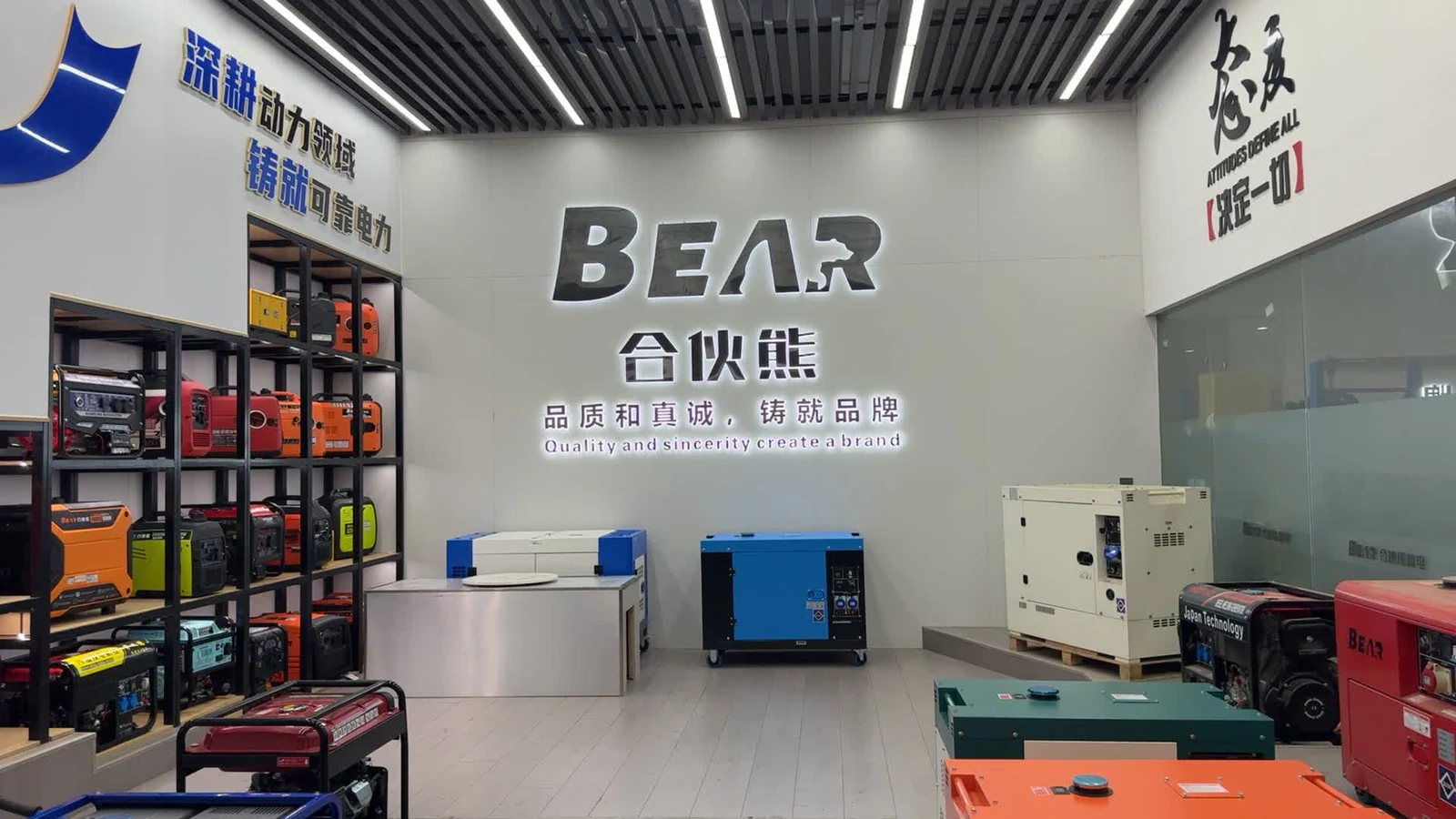
Write the intended load and operating pattern before selecting the size or format. Portable, enclosed and inverter describe different aspects of a product. Use the photographs for format orientation, then use the model documentation for the electrical design.
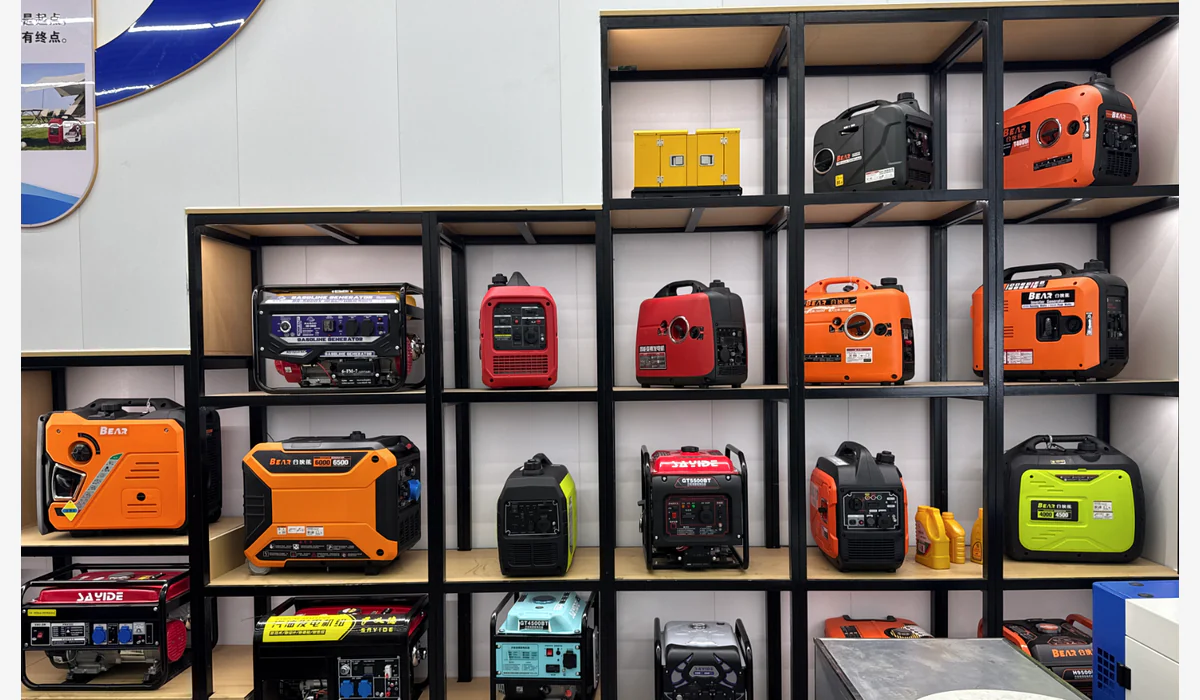
The range photo below is useful for format orientation only. It shows enclosed and open-frame products in the same buying environment, but appearance cannot confirm the internal power-conversion path.
Describe who will use the set, what runs at the same time and what starts next. Add the required outlets, daily hours and expected load changes. Then record sound limits, handling needs and the dealer's repair plan. A label such as camping, backup or jobsite is too broad to replace those inputs.
Convert the load list into electrical requirements
Make one row per load. Record voltage, frequency, phase and running demand. Add starting or inrush demand, power factor when needed, and the start order. Keep the load maker's limits beside that equipment.
Adding nameplate watts alone leaves gaps for motors, pumps, chargers, UPS and other loads. The supplier needs the full load case to judge the offered set.
| Requirement | Buyer return | Model evidence required |
|---|---|---|
| Sustained output | Simultaneous load by operating state, plus engineered margin | Rated output and duty basis at the required voltage/frequency/configuration |
| Starting/transient load | Largest starting event and sequence; permitted dip/recovery | Exact-model load-acceptance or application evidence |
| Output interface | Required outlets/terminals, conductor and protection needs | Control-panel drawing and manual for the destination variant |
| Sensitive/nonlinear loads | Device list, allowable source limits and support from device maker | Waveform and dynamic data at relevant loads, not an “inverter” label |
| Environment | Altitude, temperature, enclosure/ventilation and weather exposure | Exact derating and operating limits |
| Expansion | Future loads or parallel strategy | Verified reserve or compatible approved system |
Use the rated-versus-peak guide before comparing running and starting figures, and freeze the destination electrical fields with the voltage/frequency checklist.
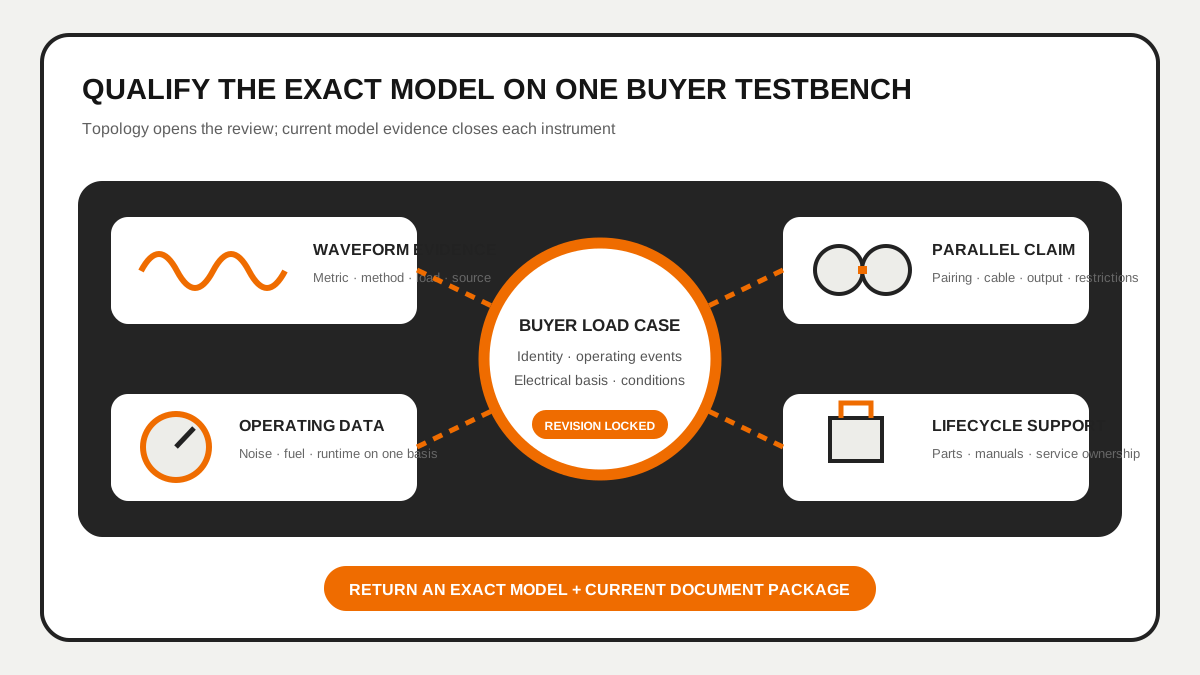
Qualify waveform and sensitive-load claims
Ask what was measured and under which load. The report needs the output setup and test method too. One total harmonic distortion (THD) percentage does not describe the full load range.
The test record should identify voltage or current distortion, the output connection and the load. Compare no load, the planned working loads and rated load where relevant. For each point, retain the test method and load type. Add voltage and frequency response when a load starts or stops.
A static waveform result does not answer a separate starting-load question. For a UPS or charger, obtain the equipment maker's source limits as well as the generator data.
Exact-model records show why the design label is not enough. The Generac GP3300i manual/spec record gives a THD value for a named configuration. The conventional Generac XT8500EFI specification also gives a model-specific THD limit.
These are not a direct product comparison: their power, builds and test contexts differ. They show that waveform claims need a model record, not just the word inverter.
“Safe for sensitive electronics” is also too broad. The load manufacturer may specify source limits, grounding/neutral, waveform, surge or UPS requirements that a generator label cannot override. Keep the claim narrow and equipment-specific.
Compare noise only under equivalent conditions
Compare noise on the same basis. Sound power and sound pressure are different quantities. For sound pressure, retain the distance or position. Both returns need the load, enclosure and test conditions.
ISO 8528-10:2022 specifies noise test codes for sound power and emission sound pressure for constant- and variable-speed generating sets. Referencing the standard does not prove a model's result unless the test file identifies the tested set, operating condition, configuration and value.
Keep these fields beside each sound result:
- Quantity: sound power or sound pressure.
- Operating point: no load, stated partial load or rated load.
- Measurement: method and environment; distance or position for sound pressure.
- Build: the tested enclosure, exhaust and cooling arrangement.
Variable engine speed does not give every model the same noise advantage. Compare the actual result for the load and build you plan to buy.
Compare fuel use and runtime at the same useful output
An “economy mode” or variable-speed statement is not an annual fuel-cost result. Compare exact models at load points that represent the intended duty, with the same useful electrical output and clearly stated fuel units.
Use fuel volume per hour and useful electrical output at the same load point. Where those values are measured over a stable period:
Fuel use per useful kWh = fuel volume per hour / useful electrical kW.
Why longer runtime can still use more fuel
This is a hypothetical arithmetic example, not a BEAR specification or a comparison of real models. Assume two candidates are tested at the same steady 1 kW output and use the stated usable fuel volume.
| Input or result | Candidate A | Candidate B |
|---|---|---|
| Usable fuel consumed | 4 L | 6 L |
| Time at 1 kW | 8 hours | 10 hours |
| Average fuel use | 4 / 8 = 0.5 L/h | 6 / 10 = 0.6 L/h |
| Fuel per useful energy | 0.5 L/kWh | 0.6 L/kWh |
Candidate B runs for longer because it carries more fuel in this example. Candidate A uses less fuel for the same output. Neither result says what happens at another load or during starting events. Tank size alone cannot answer a fuel-cost question.
For actual offers, ask for data at your useful output levels. A quarter-load test on a larger set is not the same output as a quarter-load test on a smaller set. Use supported load points and your expected hours to estimate cost; do not invent the missing curve.
The Cummins Onan portable brochure is an example of runtime recorded at defined partial loads for named models. Its results do not predict another model or buyer duty.
Confirm whether parallel operation is real and usable
Parallel ports do not prove that two sets can run together. The manual must name the permitted models and kit. Check the combined usable output and outlets for that pair. The kit, cables and instructions need to match the unit versions and market.
A Cummins P2500i owner manual describes paralleling with another named model. That example shows one manufacturer's controlled compatibility wording; it does not prove cross-brand or arbitrary same-brand pairing.
The quotation should name the permitted pair, kit and cable part number, usable combined output and relevant unit revisions. Keep the operating instructions with the kit. The dealer also needs the replacement-parts plan and the warranty scope for the combination.
Do not improvise parallel cables or connect sets whose manuals do not permit the pair. A single unit remains a valid candidate when paired use is not needed.
Evaluate maintenance, parts and distributor risk
The dealer needs a workable repair route for the exact unit. A compact case is not proof of low service cost. Ask the supplier to show routine access, the maintenance schedule and the parts list tied to the model and unit range.
For an inverter candidate, include the inverter module, control board and diagnostic process in the parts discussion. For either design, name the repair owner, stock location, parts lead time and warranty terms in the destination market. These are fields to obtain in the offer, not assumed BEAR services.
For a rental or distributor range, compare packed size and weight, storage instructions and the expected return/repair cost. If two candidates both pass the load requirements, a supported model can be a better range choice than one whose repair route is still unknown.
Clear safety, compliance and documentation gates
Portable generators create carbon-monoxide, fire, shock and backfeed hazards regardless of architecture. The US Consumer Product Safety Commission warns in its portable-generator safety guidance against indoor use and unsafe refueling/connection practices. Destination requirements, product labels, instructions and competent installation still control the actual market.
Keep the destination's required labels, languages and documents tied to the exact model. The importer and responsible local parties must settle the applicable emissions, safety, electrical and noise requirements. Also identify any battery or fuel restrictions for shipment.
The document checklist helps match the quote, model, manual and relevant records. External product examples explain what a record can look like; they do not establish BEAR availability or compliance.
Copy this inverter-generator quotation request
Supply the same brief to each bidder so the reply addresses your equipment and duty. Leave a field open when the buyer does not yet know it; a supplier's guess should not become the design requirement.
Destination and sales channel: [market; dealer, rental or end-user application]
Loads and sequence: [equipment list, running demand and starting events]
Electrical output: [voltage, frequency, phase and required outlets]
Operating pattern: [hours by load level; noise and portability needs]
Parallel use: [required, optional or not required; proposed combination if known]
Service: [repair location, response needs and initial spare-parts requirement]
Quantity and delivery: [planned quantity and destination]
Please return: exact model and variant, rated/maximum output, relevant waveform and load-response data, comparable fuel/noise data, manual, parts support, applicable market documents and a quotation showing deviations.
A parallel kit is a required return only when paired operation is part of the buying case. If it is not needed, record it as not applicable instead of rejecting an otherwise suitable standalone model.
Decide which candidates to retain
Use these five checks for each candidate, marking paired use as not applicable when it is outside the intended application. A product label cannot replace the required data.
| Gate | Required return | Keep on HOLD when |
|---|---|---|
| Load | Simultaneous running loads, start order, hardest start, rated output, start headroom, voltage, frequency, phase and outlets on one basis | Peak output is used as sustained capacity, or the hardest start is not evaluated |
| Power quality | THD or waveform data at named loads, plus voltage and frequency response for the defined load event and any load-maker limits | “Clean power” or one THD point replaces the required operating range and transient review |
| Sound and fuel | Sound metric, load, distance and method; fuel unit, time, tank size where runtime is used, and useful output | Test bases differ or runtime is compared without its tank size and load |
| Paired use | Exact permitted set pair, cable or kit, unit-range limits, and the applicable start, load-share and stop instructions | The guide does not name the pair, or visual connector similarity is the only evidence |
| Support | Model- and unit-range-specific manual, parts list, service route, first-order parts plan and electronic-part diagnosis owner | The target market has no identified record, parts or response owner |
Give each gate one state:
PASS: the exact set clears the buyer's need with fitting proof.HOLD: a key fact, test point or source is still open.NO FIT: the set fails a fixed load, market or service need.
Do not add the gate states into a score. One NO FIT can end the choice, and soft benefits cannot cancel a failed load or market requirement.
For the final decision, keep a one-page comparison with the requirement, returned value, source and unresolved item for each applicable gate. A failed fixed requirement can remove a candidate; missing evidence calls for a follow-up. Features unrelated to the intended use should not decide the purchase.
Start with the gasoline inverter generator range, then send the selected candidate and completed brief through the quotation inquiry. For a conventional alternative, compare the open-frame gasoline range using the same load and electrical requirements.