
Convert a commercial brief into a complete gasoline portable generator configuration: start type, outlets, protection, certification by market and an RFQ field sheet.
In this guide6 sections
Specify the destination market, loads, sales channel and quantity before requesting a gasoline portable generator quote. Turn that brief into a configuration covering output, start type, outlets, protection and supplied accessories. Keep the order open until the supplier confirms the build and applicable destination documents.
Start from the commercial brief, not a product ranking
Define the commercial context first, because it sets every later choice: the target market and its supply (voltage, frequency, plugs), the sales channel (retail, e-commerce, wholesale, rental), the user scenario (contractor, farm, outdoor, light commercial), the price tier and the expected order volume. A model that fits one brief is wrong for another at the same wattage.
Lock the core configuration
Turn the brief into a defined build. Do not leave these to the supplier's default, or two quotes will not be comparable.
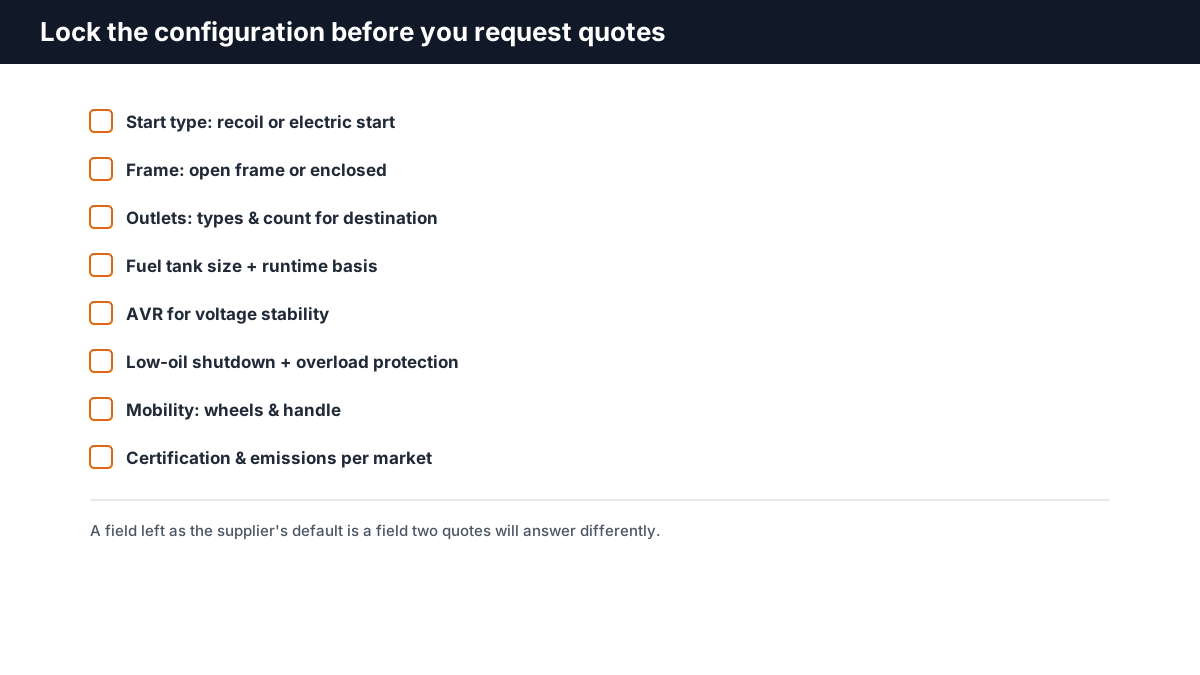
Cover at least: start type (recoil or electric start), open frame vs enclosed, outlet types and count, fuel tank and the runtime basis, AVR for voltage stability, low-oil and overload protection, and mobility (wheels and handle). Outlet types must match the destination — see the outlets, receptacles and plugs guide.
Verify voltage regulation, protection and site safety
Ask the supplier to confirm low-oil shutdown and overload protection on the exact model. Record AVR separately as voltage regulation; it does not replace overload or electric-shock protection. Have the grounding and bonding arrangement checked against the equipment instructions and destination requirements. The OSHA portable-generator grounding fact sheet provides US guidance; it does not establish compliance in another market.

Match certification and emissions to the market
Engine emissions and product-safety requirements differ by market, and a catalogue mark does not establish destination compliance. The US EPA certification guidance distinguishes small and large nonroad spark-ignition engine rules, with separate evaporative-emission requirements where applicable. Confirm the applicable route for the exact engine family, model year and equipment; do not assign every engine to one rule from the generator’s marketing name. Request the matching documents using the import compliance by market guide and the documents-before-order checklist.
Build the gas-portable RFQ field sheet
Send the destination, loads and quantity with one list of required configuration fields. Ask each supplier to return a value, source or stated exclusion for every line.

Ask the supplier to confirm, per model:
- Rated and peak output and the rating basis (see the rated versus peak guide).
- Start type, frame type, outlet types/count and mobility.
- Fuel tank size and the runtime basis (tank + load point).
- AVR, low-oil shutdown and overload protection fitted.
- Certification and emissions applicable to the destination market.
- Destination voltage, frequency and phase (see the voltage and frequency checklist).
- Packaging, carton size/weight, forecast quantity and any acceptance test.
If the customer also wants LPG flexibility, move to the dual-fuel guide instead of forcing it onto a gasoline-only build.
Common mistakes to avoid
- Sourcing on headline wattage and price instead of a defined configuration.
- Leaving start type, outlets or protection as supplier defaults.
- Accepting a runtime figure without its tank size and load basis.
- Treating a catalogue mark as destination certification or emissions compliance.
- Ignoring destination outlet types and voltage/frequency.
Send your commercial brief and configuration to request a quotation. BEAR confirms the exact model configuration, protection, applicable documents and acceptance terms per order; figures and certificates are verified for the quoted build rather than assumed from this guide.