
Choose a generator for your food truck using service loads, portable or installed layouts, model evidence, fuel planning and a supplier-ready checklist.
In this guide5 sections
The best generator for your food truck is the candidate whose proposal accounts for your simultaneous appliances, documented starting loads and accepted site layout. Start with those inputs, then compare exact models. Choose an outdoor portable arrangement or a purpose-designed commercial mobile installation before treating their offers as comparable.
Aim for a model proposal that names its supported loads, connection and fuel plan for the shift. The truck builder and site operator also need to accept that arrangement.
What size generator does your food truck need?
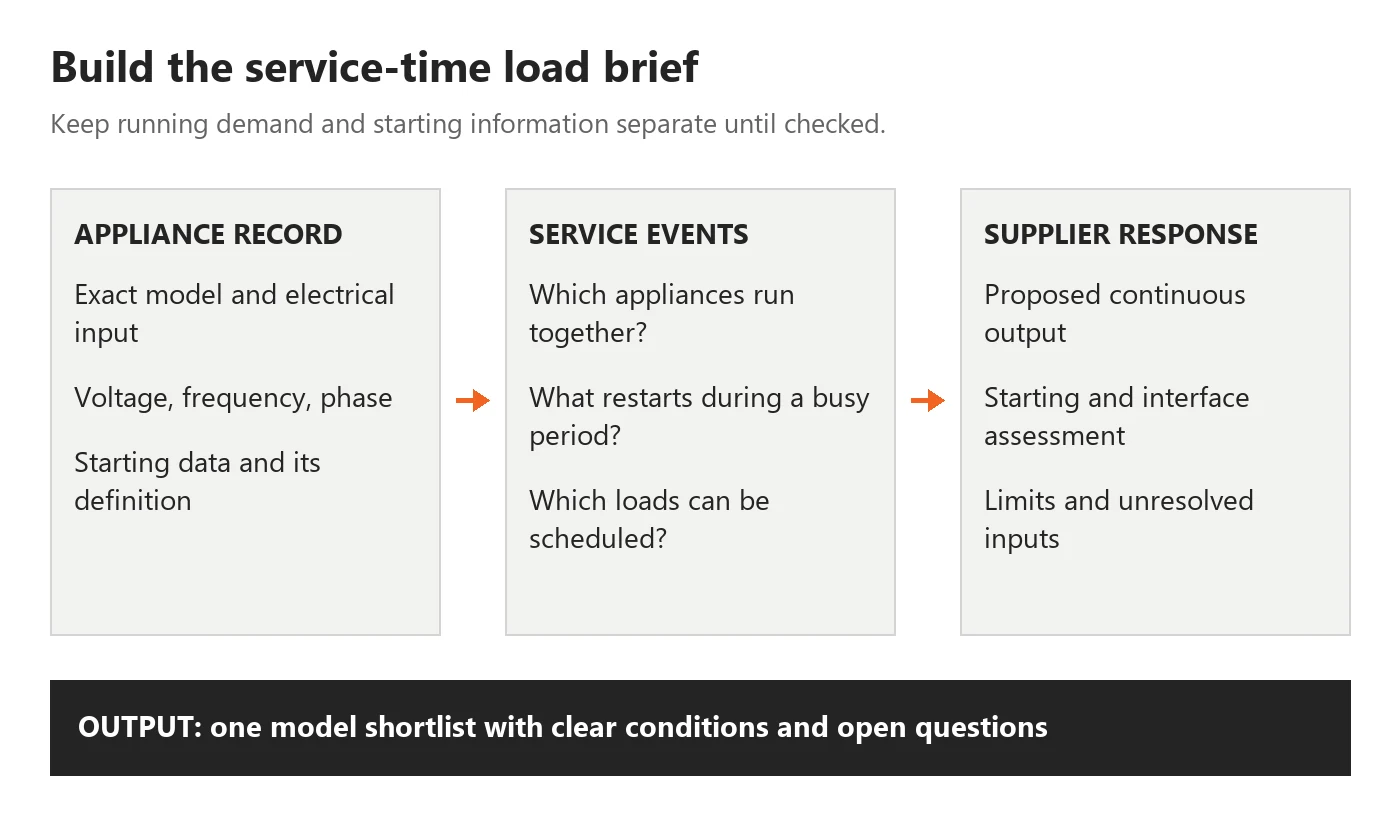
Start with the busiest part of your shift. Record each appliance model, its electrical input and its starting data. Mark which loads run together. A menu such as “coffee and snacks” cannot supply those details.
Create a record for each item you plan to power. Include fridges, cooking equipment, fans, water pumps, lights, payment devices and any heating or cooling. Use the electrical input on the exact appliance label or in its manual.
Keep heating output, electrical input, running demand and starting demand in separate fields. Leave an unknown value open. It is a question for the supplier, not a zero to put in a sum.
Send the service-event register below with your request for a size recommendation. It tells the supplier what to assess. It does not calculate a generator size.
| Service event | Record these inputs | Supplier must resolve |
|---|---|---|
| Preparation before opening | Equipment used for preheating, chilling, cleaning and setup | Whether this creates a different demand from serving customers |
| Busiest service period | Appliances expected to run together, with exact models and input data | Continuous output for this combination |
| A motor or compressor starts | Which item starts, its manufacturer starting data, and loads already running | Starting capacity under that particular overlap |
| Restart after a power interruption | Which appliances restart automatically and which need an operator | Any sequencing conditions or unresolved starting data |
| Between service periods | Loads that must remain powered and tasks that can move to another time | Whether the proposed operating plan is practical for your staff |
Take this hypothetical example: a coffee truck must keep its fridge on during service. Staff can heat cleaning water after closing. The quote should state whether it relies on that timing. If staff use both loads at once, they have changed the case the supplier assessed.
Only propose a sequence the team can follow. If cooking and refrigeration must overlap during service, keep both in the assessed operating case. Move a load out of that case only when the work plan actually keeps it off. Missing starting data leaves the shortlist provisional; a larger advertised peak rating does not supply that input.
A small generator for a food truck may fit the plan once these inputs are checked. Size is still a result to prove. A 10,000- or 12,000-watt headline also leaves open which loads may share an outlet. Ask for the rated continuous output and the limits of the proposed connection.
Choose between outdoor portable and installed power
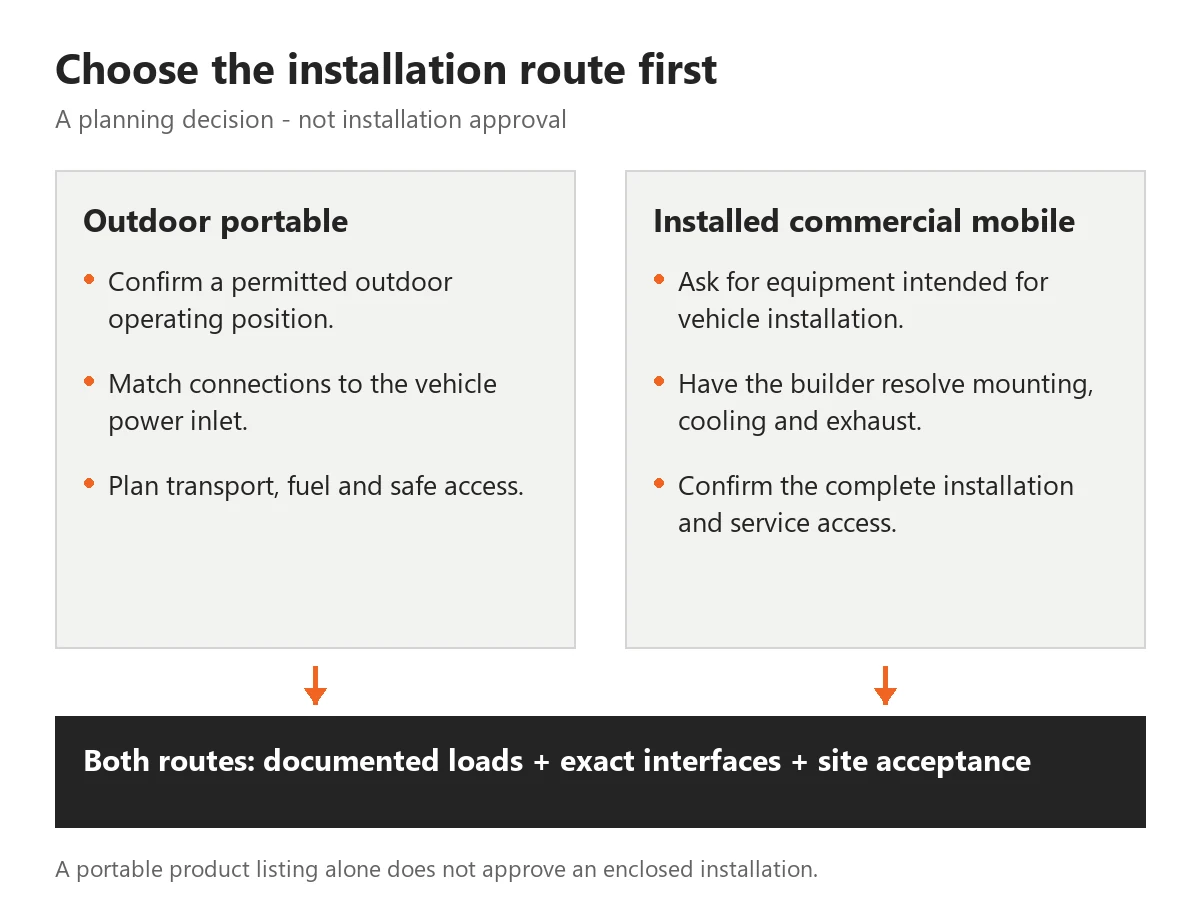
Choose the operating layout first. For a portable unit, record the outdoor position, how it moves between venues, the truck connection and fuel handling. For a built-in unit, start with a commercial mobile range. Have the truck builder assess the whole design.
A portable product listing does not approve use in an enclosed truck compartment. Give the builder the exact model documents and site layout. Show openings, airflow, exhaust, access and the proposed power connection. Obtain an installation proposal for that setup.
Keep enclosure, exhaust and wiring design with the responsible installer. A buying guide cannot supply those instructions for an unknown truck.
The site plan needs review too. The NFPA food-truck safety checklist covers exhaust near openings, air intakes, exits, buildings and cooking areas. It also calls for separating engine-driven power sources from the public.
Use the checklist with the exact model instructions and local site rules. Have the site operator and local authority resolve what applies. A single distance from a buying guide does not approve every layout.
List each type of venue the truck will visit. A plan accepted at one market may leave questions at the next. Where the site offers shore power, include that option. Have the installer specify how the truck would use it.
A shortlist with a reason for every entry
Build the shortlist around three decisions. For outdoor portable power, compare the exact model against the appliance register, truck connection and permitted operating position. For built-in power, require a commercial mobile proposal and a reviewed vehicle layout. For a configurable supplier enquiry, keep the entry provisional until the supplier returns a named configuration and matching documents.
The examples below show those different buying routes. They are not a ranked test of like-for-like models, and a brand name alone does not close any of the three decisions.
| Buying route | What the named source establishes | What you still need before selecting |
|---|---|---|
| Honda EU7000iS, US model | Honda lists 120/240 V output, 5,500 W rated and 7,000 W maximum | Assessment against your loads, connection, site arrangement and operating schedule |
| Cummins commercial mobile range | Cummins identifies food service among its commercial mobile applications | Exact model, fuel, continuous rating and vehicle installation proposal |
| BEAR configuration enquiry | A route to discuss the configurable catalogue against your requirements | A named configuration, matched documents and confirmation of application fit |
The official Honda EU7000iS specifications show why rated and maximum output need separate fields. Honda lists the US model at 5,500 W rated and 7,000 W maximum. Keep the rated value in the sustained-load check. Ask the supplier to explain its separate starting assessment.
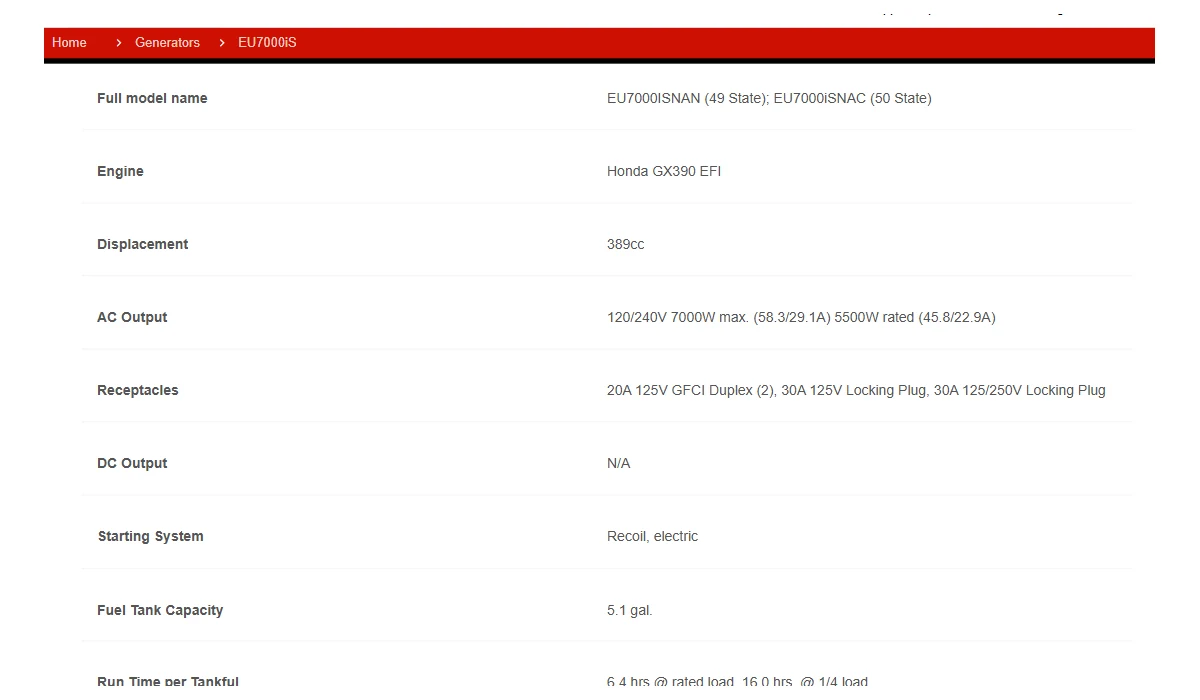
The model name and peak number cannot settle the choice. You still need the load case, connection limits and site plan.
For a built-in route, Cummins commercial mobile generators are a range to explore. The manufacturer names food service among its uses. Get the exact model and its installation documents before comparing offers. The range page does not give the rating or approval of an unnamed unit.
For a BEAR enquiry, use the gasoline inverter generator category if that type fits the plan. Send the load record, destination and layout. Ask which configuration can be offered and what still needs review. No BEAR model is named here as an approved food-truck generator.
Considering an inverter generator for a food truck? Include any power-quality limits set by the appliance maker in the enquiry. The inverter label does not complete the match. Voltage, frequency, phase, rated output and the actual connection still need checking.
Plan noise, fuel and the full service shift
Compare sound claims on the same basis. To assess a claim about the quietest generator for a food truck, record the test load, distance and method beside the sound value. Add the venue rule you must meet. A number without those details leaves the comparison open.
Runtime also depends on the stated test load. Honda lists the US EU7000iS at 6.4 hours at rated load and 16 hours at quarter load. These manufacturer values cover different operating points. They do not promise a 16-hour shift on your truck.
Give the supplier your shift plan. Ask which runtime point it used and how fuel needs will be confirmed. The figures above are not an independent food-truck test.
Include the full working day: setup, food prep, service, cleaning and any fridge load between shifts. State what stays on after the serving window shuts. A quote based only on opening hours leaves those periods open.
Plan fuel stops around the safety rules. NFPA calls for refuelling during non-operating hours. Before refuelling from a portable container, its checklist requires the power source to be shut down and its surfaces cool to the touch. Do not plan a quick refill during the lunch queue to extend a shift.
Agree who handles a failed start and where the exact model can be serviced. Obtain its manual, the supplier's service contact and the required parts list. A warranty term alone does not explain how the truck returns to work.
Send one complete request for quotation
Send each supplier the same appliance register, shift plan and layout. Ask for a named model and the terms behind its proposed use. Compare the replies before buying equipment or changing the truck.
The supplier return pack should answer these points:
- Equipment identity: exact model, fuel option and configuration, with matching datasheet and manual.
- Electrical match: voltage, frequency, phase, rated output, starting assessment and the proposed outlet or vehicle interface. If the requirement is described as “220 V,” have the exact nominal supply and appliance ratings resolved in writing.
- Operating case: the equipment that may run together, any required sequencing and the unresolved inputs that could change the proposal.
- Physical arrangement: intended portable position or installed layout, access for maintenance and the party responsible for installation review.
- Shift plan: the load conditions behind runtime and sound data, planned fuel stops and responsibilities during an interruption.
- Commercial scope: destination, quantity, supplied accessories, exclusions, documentation and the support contact for that exact offer.
Use current photos of the quoted version to locate the panel and show where access is needed. Request those views with the offer. A general equipment image cannot supply the answers for a particular model.
Make the buying decision when the model, load case, connection and layout can be checked together. If a missing input could change the recommendation, leave that entry open.
Use the generator documents before order checklist to match the files to the offer. To discuss a BEAR configuration, send your load plan and destination through the enquiry form. State whether you need outdoor portable power or a vehicle installation proposal.