
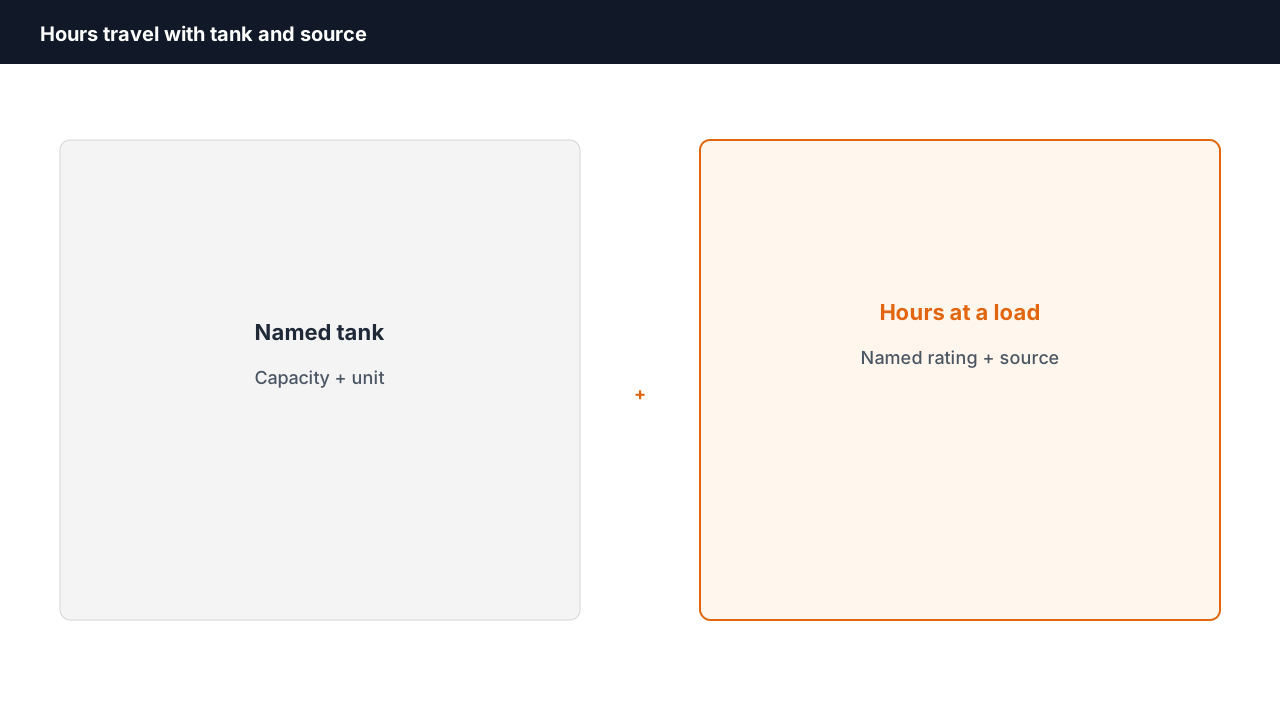
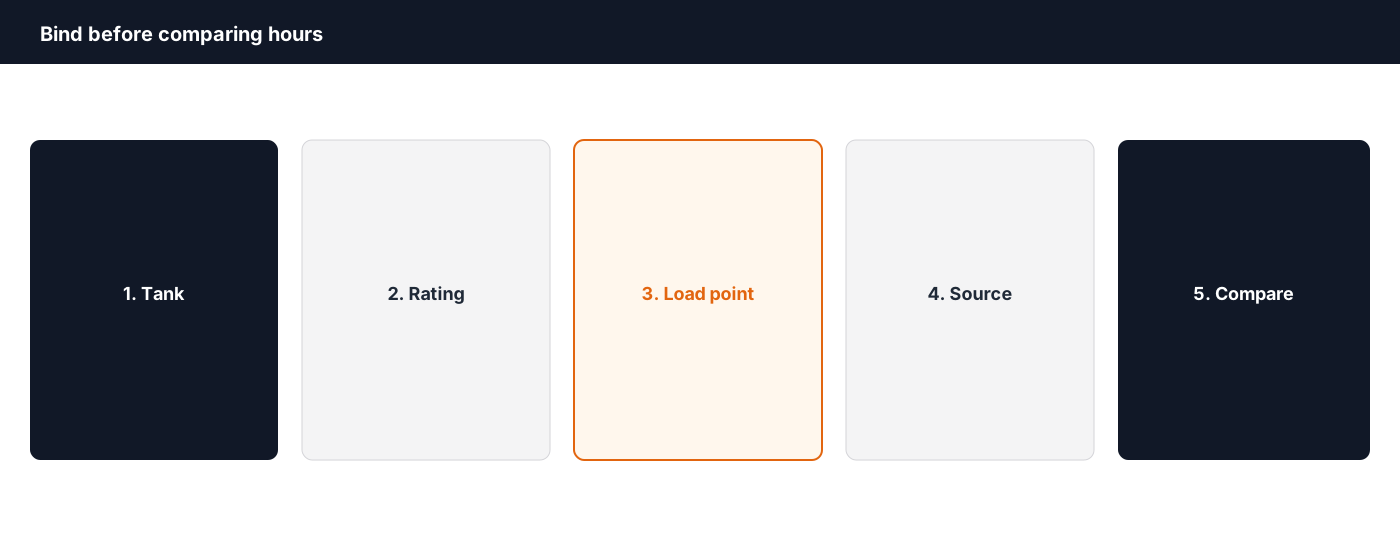
Compare claimed runtime hours only when tank size, load point and claim source sit on one card. Do not use a universal litres-per-hour.
In this guide5 sections
A runtime-hour figure is comparable only when tank size, load point and claim source sit on the same card. Hours without those three fields are HOLD. Do not invent a universal litres-per-hour and do not treat one brand chart as a fleet rule. This page is for importers, distributors and rental buyers who must print hours on a SKU card. It is not a diesel plant fuel-quotation method.
Diesel L/h at a named duty stays on the diesel fuel-consumption quotation checklist. Load listing stays on what size generator do I need.
Hours are not comparable until three fields share a card
Write tank capacity with its unit, the load point as a share of a named rating or as electrical kW, and the document that owns the hours. A runtime figure without those fields does not pass.
Rated and peak labels of the set still follow the rated versus peak guide. Hours at an unnamed “50% load” are HOLD until the seller names 50% of which rating.
ISO 8528-1 is generating-set terminology. It does not publish a portable hour chart.
Do not invent a universal litres-per-hour
Fuel family, governor setting, altitude, temperature and accessories change fuel flow. A portable hour claim is not repaired by dividing tank litres by a stock L/h.
If the seller gives a fuel rate, record its units, load point and source separately. Usable fuel volume in litres divided by consumption in litres per hour at that load gives an estimate of hours; this ratio does not need fuel density. A mass-based rate needs the appropriate mass-to-volume conversion first. Confirm usable tank volume, fuel grade, operating mode and test conditions before presenting the estimate as a runtime claim.
Separate tank hours from service interval and duty
Hours on a tank are not oil-change hours, not rental-shift hours, and not a continuous-run permit. Print them as different fields.
If the SKU card also claims eco-mode or inverter economy, require the same three-field bind with that mode named. Mixing eco-mode hours with full-load hours on one line is HOLD.
Electrical version still belongs on the voltage and frequency checklist. Wrong voltage or frequency makes the hour claim belong to a different machine.
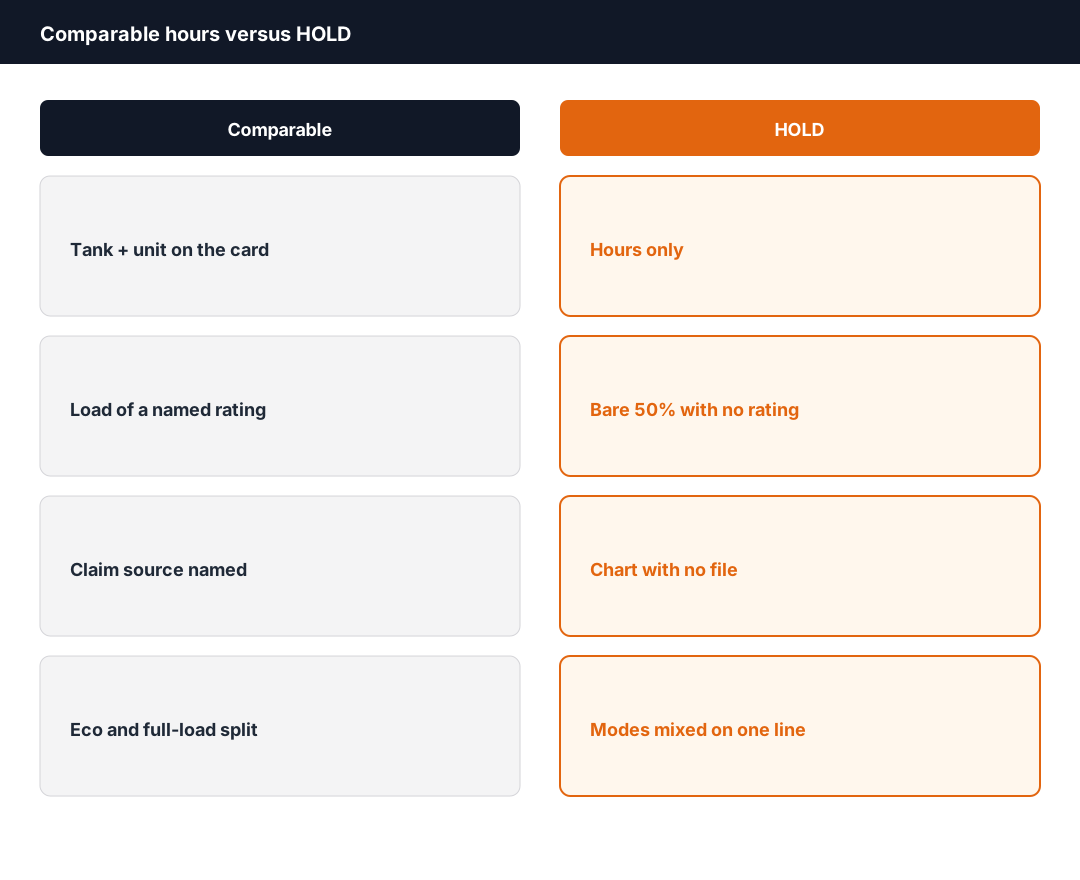
Runtime HOLD table
| Field | Passes | HOLD |
|---|---|---|
| Tank | Capacity and unit on the same card as hours | Hours only |
| Load point | Share of a named rating or kW at that point | “50%” with no rating |
| Claim source | Datasheet, test note or manual revision named | Marketing hour chart with no file |
| Mode | Eco/full-load named if used | Eco hours mixed with full-load hours |
| Fuel rate | Separate row with its own bind, or omitted | Universal L/h used to invent hours |
| Duty vs service | Tank hours kept apart from service interval | One “hours” field for both |
| Electrical version | Voltage and frequency match the quoted set | Hours copied from another version |
What to send with the request
State the market, application, expected load point, voltage, frequency, phase, quantity, model if known, tank unit you want printed, and the hour claim you were given if any.
Ask the supplier to return tank, load point and source on one line, eco-mode yes/no, any fuel-rate row with its own bind, and the matching manual page. Start from the gasoline generator category or the diesel generator category by fuel. Printed hours are confirmed only on the named set through the project form.