
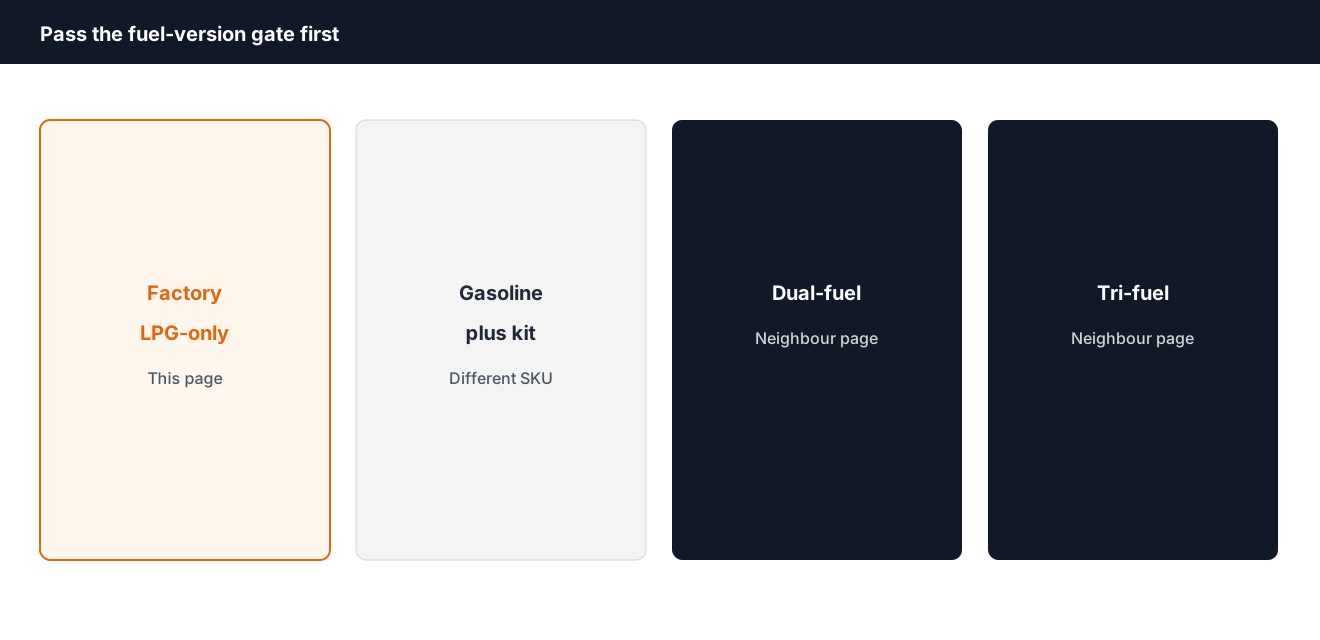
Confirm a factory monofuel LPG version before price. A gasoline set plus a kit is a different product from a factory LPG build.
In this guide5 sections
LPG-Only Generators are a factory monofuel version. They are not a gasoline set with a kit in the crate. They are not dual-fuel or tri-fuel. Keep the card on HOLD until the seller names the fuel version as built. This page is for importers, distributors, rental fleets and OEM buyers. It is not a site gas-piping design.
Gasoline plus LPG on one machine belongs on the dual-fuel buyer guide. Natural-gas as a third path belongs on the tri-fuel guide.
Name the fuel version before comparing price
Write the buy path: factory LPG-only, or a gasoline SKU plus a kit. “LPG generator” without that fork does not pass.
If the user must keep gasoline, leave this page. If the market has no lawful LPG supply, an LPG-only SKU is the wrong product.
OSHA, Using Portable Generators Safely is outdoor-use context. It does not prove a fuel version.
A kit on a gasoline set is not an LPG factory version
A kit quote must name the kit maker. It must name the gasoline model it fits. It must name who fits it. It must name which ratings apply after fit. Mixing those files with a factory LPG sheet is HOLD.
A factory LPG version needs its own model code. It needs its own mixer or carb id. It needs its own regulator path. It needs a rating that belongs to LPG. Do not take a gasoline wattage with the word propane in the ad.
Rated and peak labels still split as in the rated versus peak guide. Each label must say which fuel owns it.
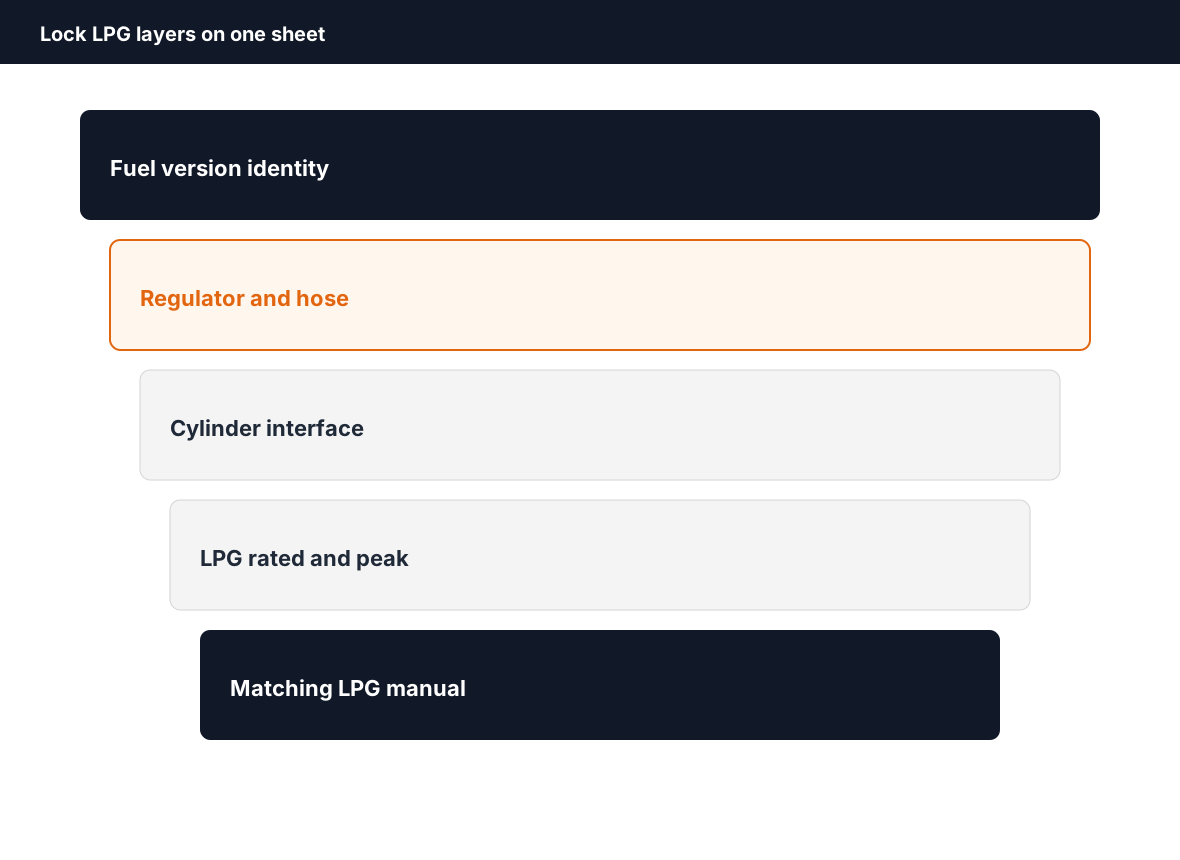
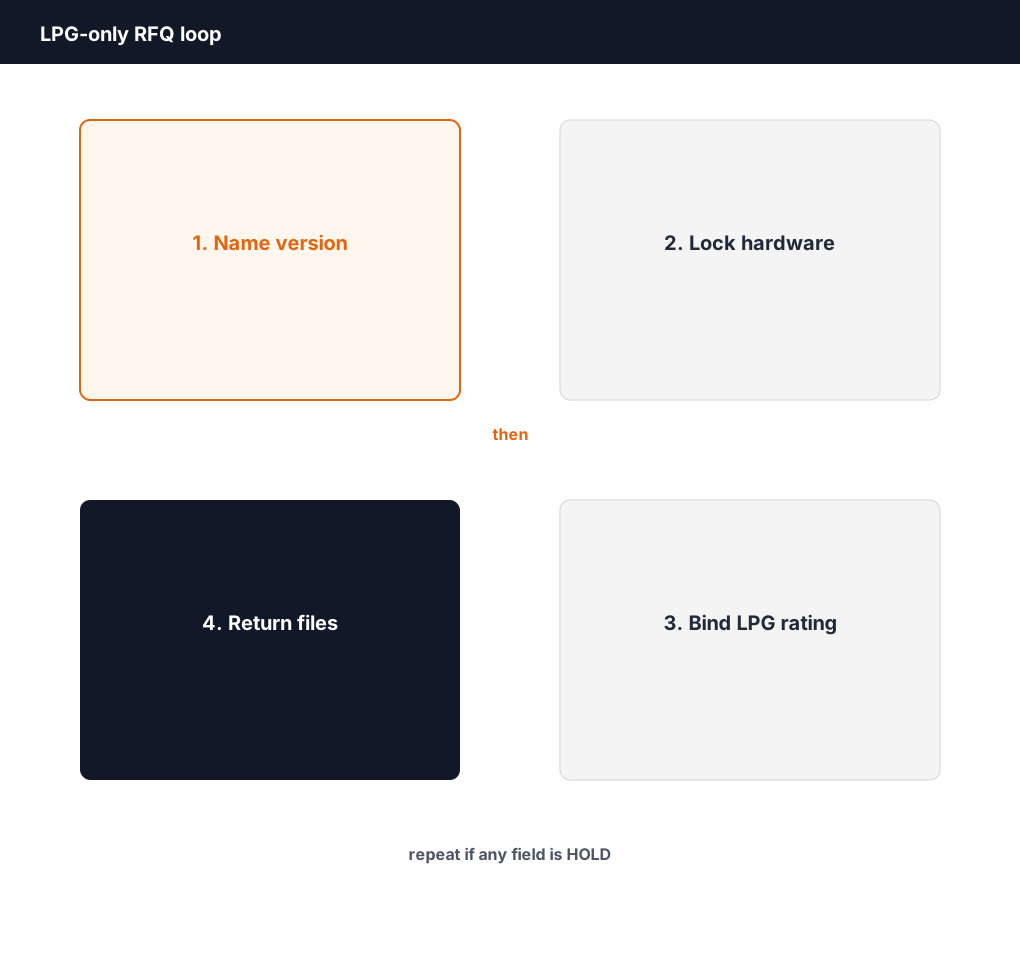
Lock LPG hardware, rating and documents on one sheet
Name the regulator, hose, connector and bottle path. Say if each item is in or out. “Typical propane kit” is HOLD.
Freeze voltage, Hz, phase and outlets with the voltage and frequency checklist and the outlet and plug guide. Market fuel-gas and product rules stay buyer-check fields. A catalogue mark is not market proof.
ISO 8528-1 is set terms. It does not turn gasoline output into an LPG version.
LPG-only HOLD table
| Field | Passes | HOLD |
|---|---|---|
| Fuel version | Factory LPG-only is named | Gasoline plus kit mixed into one SKU |
| Neighbour fuels | Dual-fuel and tri-fuel sent to their pages | “Gas” used for all fuel paths |
| Kit identity | Kit maker, host model and installer named, or no kit | “Convertible” with no file |
| LPG rating | Rated and peak stated for LPG | Gasoline watts plus the word propane |
| Hardware | Regulator, hose, connector, included/excluded | “Typical accessories” |
| Documents | Manual and datasheet match the LPG version | Gasoline files reused |
| Market rules | Destination fuel-gas and product marks are named fields | Catalogue mark treated as destination proof |
What to send with the request
State the market, use, load, voltage, Hz, phase and quantity. Say if the SKU must be factory LPG-only. Name the bottle path if you know it. Attach the files you already hold.
Ask the seller to return the fuel version without mixing a kit. Ask for LPG ratings apart from any gasoline host. Ask what hardware is in or out. Ask for photos of the regulator path, the matching book and what is left out. Start from the gasoline generator category when the platform is spark-ignition. Keep the LPG version distinct. Terms lock only on the named version through the project form.